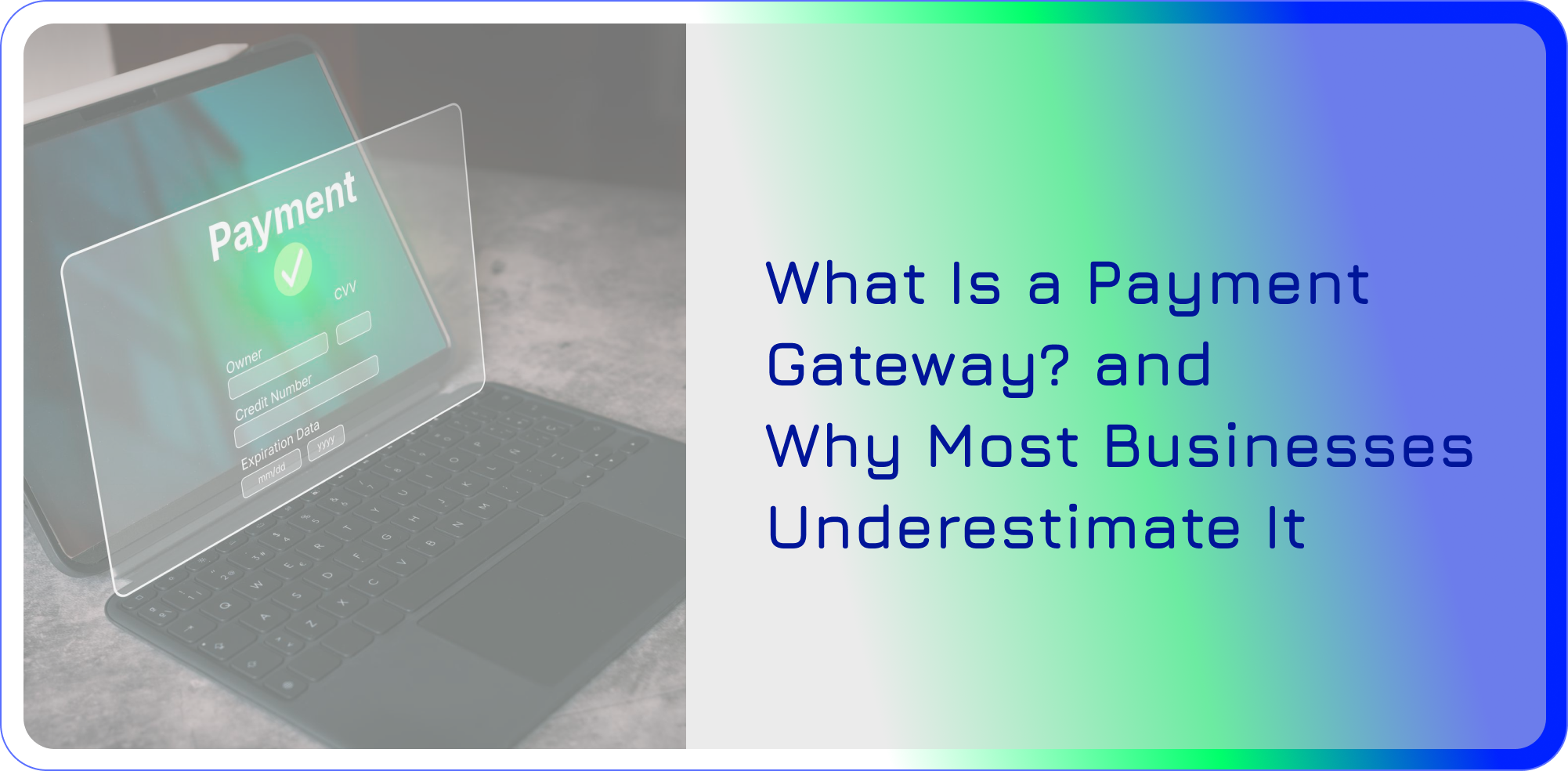
When a customer taps “Pay Now,” the transaction resolves in under three seconds. What happens in that window is far more complex than it appears. In those seconds, encrypted card data travels through a payment gateway, reaches a processor, is routed through a card scheme (Visa, Mastercard, or equivalent), validated by the issuing bank, and returned to your server, all before the confirmation page loads.
Understanding this architecture is not an academic exercise. For any business that accepts online payments, the payment gateway is infrastructure, as foundational as your hosting environment. Choosing, configuring, and monitoring it correctly has a measurable impact on revenue, conversion rates, and operational risk.
What a Payment Gateway Actually Does
A payment gateway performs four core functions in every transaction:
- Data capture and encryption: Sensitive card information entered at checkout is immediately encrypted using TLS and tokenised before leaving the customer’s browser. This prevents exposure of raw PAN (Primary Account Number) data at any point in the transaction chain.
- Routing and authorisation: The encrypted payload is forwarded to the acquiring bank’s processor, which routes it through the relevant card scheme to the issuing bank. The issuer checks available funds, fraud signals, and authentication status before returning an authorisation code or a decline reason.
- Response handling: The authorisation response — approval, soft decline, or hard decline — is passed back through the same chain and interpreted by the gateway, which triggers the appropriate outcome on your checkout page.
- Settlement instruction: Approved transactions are batched and submitted for settlement, typically within 24 hours, at which point funds begin their journey from the issuing bank through the card scheme to your acquiring bank.
This flow is invisible when it works correctly. It becomes very visible when it doesn’t.
How Gateway Architecture Directly Affects Revenue
Authorisation Rate
Every failed authorisation is a lost sale. Gateways that maintain strong acquiring relationships, support adaptive routing, and transmit rich transaction data to issuers consistently achieve higher approval rates than those that do not. A 1–2% improvement in authorisation rate across significant transaction volumes translates directly into revenue recovered with no increase in marketing spend.
Latency
Processing speed matters, particularly on mobile devices. Studies consistently show that checkout abandonment increases measurably when page transitions take more than 2 seconds. A gateway that introduces unnecessary latency at the payment step (even 400–800ms) erodes conversion rates. Infrastructure decisions like co-location with acquiring banks, efficient API design, and connection pooling all contribute to transaction speed.
Reliability and Uptime
A gateway that goes down during a peak sales period can cost more in minutes than infrastructure upgrades cost in months. When evaluating providers, SLA commitments and historical uptime records are not marketing materials, they are contractual baselines that should be scrutinised carefully.
Security Architecture
PCI DSS compliance is a minimum requirement, not a differentiator. What matters beyond compliance is the implementation: whether tokenisation is applied at the point of entry, how 3D Secure is handled (does it create friction for legitimate customers or intelligently route low-risk transactions through frictionless flows?), and how fraud signals are shared with issuers to improve authorisation quality.
What to Evaluate When Choosing a Gateway
| Factor | What to Look For |
| Acquiring relationships | Direct connections to major acquirers in your target markets; fallback routing to secondary acquirers |
| Tokenisation standard | Network tokenisation support (Visa Token Service, Mastercard MDES) for higher approval rates on recurring charges |
| 3DS2 implementation | Frictionless flow for low-risk transactions; step-up only when genuinely required by the issuer |
| Reporting depth | Transaction-level decline reason codes, not just aggregate success/failure rates |
| Integration flexibility | Support for hosted fields, direct API, and SDK options depending on your checkout architecture |
| Scalability | Demonstrated ability to handle peak traffic without degraded performance — request load test benchmarks |
Common Mistakes to Avoid
Treating the gateway as a commodity and choosing on price alone is the most common mistake. Two gateways priced identically may deliver materially different authorisation rates in specific geographies, for specific card types, or at specific transaction values. The only way to know is to benchmark.
A second common mistake is underinvesting in integration quality. A gateway with excellent infrastructure will underperform if it is integrated with deprecated API versions, omits recommended transaction metadata, or is configured with overly aggressive fraud rules that block legitimate customers.
At EVOXO, our gateway is built on direct acquiring infrastructure with intelligent routing, network tokenisation support, and transaction-level analytics. We give merchants the visibility and control to treat payment performance as a measurable business variable rather than a black box.
| Key Takeaways |
|---|
– A payment gateway routes, encrypts, authorises, and settles every transaction; it is not a commodity feature. – Authorisation rate, latency, and uptime each have a direct, quantifiable impact on revenue. – Evaluate gateways on technical depth: acquiring relationships, tokenisation standard, 3DS2 handling, and reporting granularity. – Integration quality matters as much as gateway quality — poor configuration wastes strong infrastructure. |